
role
Sole UX designer
type
Enterprise, SaaS

CarbonDeeds
Empowering individuals and organizations
to take sustainable behavior
Dashboard design, gamification, concept, research
Website
·
2025
·
Team: Solo Product Designer (me), Design Mentor

BACKGROUND
Inspired by my Arbor Day Internship, I built CarbonDeeds as my capstone
CarbonDeeds grew out of my time at Arbor Day Foundation, where I saw how hard it is to turn environmental intent into consistent action even for people who genuinely care. At work, sustainability usually stops at recycling bins and occasional email reminders. There's no clear path for employees to take real, measurable carbon action, see their impact, or feel accountable to anyone but themselves.
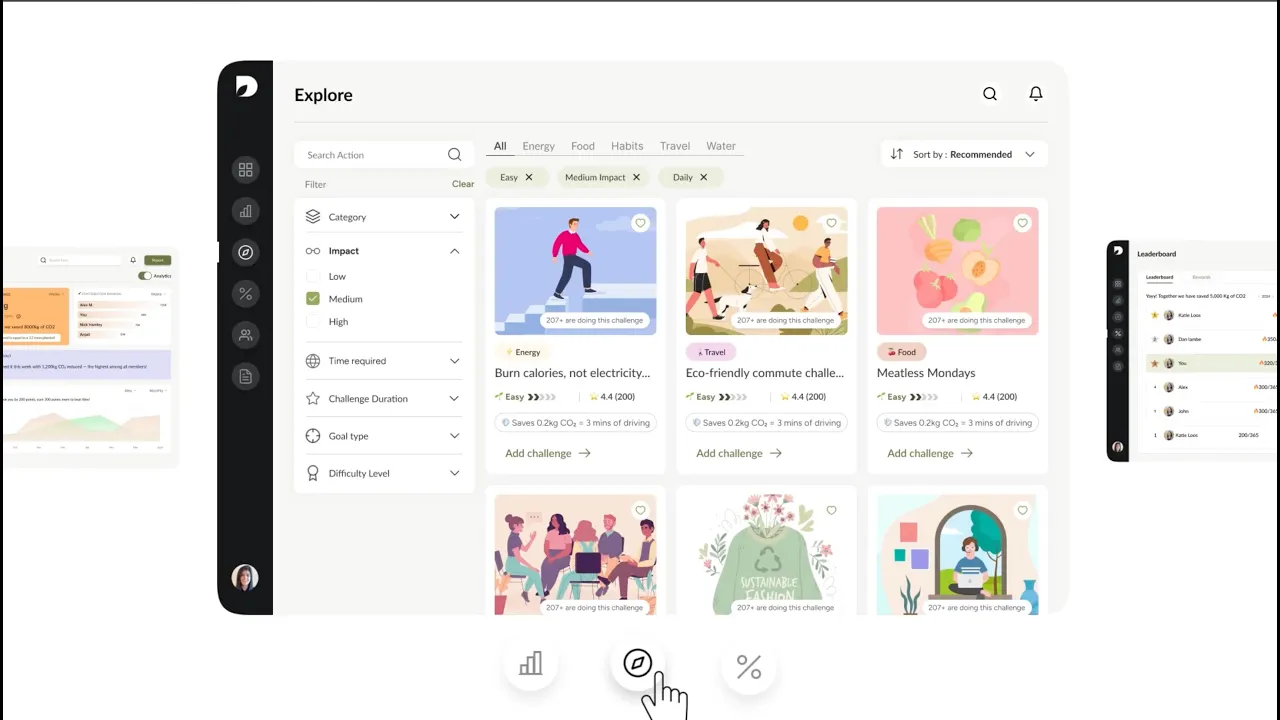
CarbonDeeds is a workplace platform that turns individual sustainable actions into carbon sequestered, tracked, and shared. It gives employees a way to act, gives teams a way to inspire and hold each other accountable, and gives the organization a way to recognize progress through earned benefits tied to real goals.
Early concepts sprawled across education content, social feeds, and gamified badges. What moved the needle was narrower: compatibility guidance, matching people to actions that actually fit their role, location, and effort level paired with clear goal tracking. That focus is what turned a pile of features into a measurable system.
KEY LEARNINGS
What this project taught me
Working solo on CarbonDeeds meant every decision from scope, direction, trade-offs was mine to make and mine to defend. There was no team to split ambiguity across, no PM to draw the line between "nice to have" and "necessary." I had to build that judgment myself.
The biggest shift was learning to sit with an unclear problem long enough to actually understand it, instead of rushing to a solution to feel productive. Early on, I wanted to build everything social feeds, education content, gamification because it felt safer to cover more ground. Working alone forced me to get comfortable cutting things without anyone to validate the call. Research became the tool I used to make that judgment defensible, not just a step to check off.
I also learned how much harder it is to stay honest about your own work without a team's outside perspective. I had to build in my own checkpoints, going back to research, testing assumptions, questioning my own attachment to ideas instead of relying on a critique cycle to catch blind spots for me.
By the end, the skill I walked away with wasn't just "how to design a product." It was how to make good decisions alone, under ambiguity, and take full ownership of the outcome.