role
UX Design Intern (Sole Designer)
type
Consumer E-commerce, Website
My contribution
I owned the PDP redesign from research synthesis and opportunity prioritization through interaction design, prototyping, validation, and high-fidelity UI, partnering with Product, Engineering, E-commerce, and Support throughout the process.

Arbor Day Foundation
Reducing uncertainty in tree shopping
Helped shoppers assess tree suitability and understand delivery expectations by making critical product information easier to find, reducing pre-purchase support contacts by 48%
12 Weeks
·
2024
·
Team: UX Designer (me), Design Manager (mentor), Business Analyst, Marketing & Data Analyst


,
−48%
Pre-purchase support contacts
+10pts
,
NPS score
+12%
,
Add-to-cart rate
OVERVIEW
Customers lacked the information needed to choose the right tree
Arbor Day's e-commerce experience offered hundreds of tree varieties, but customers often lacked the information needed to confidently decide what would work for their location, space, and level of experience.
That uncertainty created hesitation at the point of purchase and drove customers to seek additional support before buying.
Before

After

PROCESS
The existing experience provided product details, but critical questions around compatibility, shipping, and suitability were fragmented across the journey.


❌ Compatibility information was missing
❌ Shipping information appeared too late in the journey
❌ Generic product information didn't resolve personal questions
❌ Doesn't auto captures customer location/zip code
PLP
Shopping home page
PDP
I combined behavioral and attitudinal research to
understand where purchase confidence broke down.
2K+
Support ticket analysis
03
Hotjar heatmap analysis
50
User surveys
04
Competitive analysis
Surveys helped identify recurring concerns at scale, while interviews and usability sessions revealed why customers hesitated and what information they needed before adding a tree to cart.
Research
Details
FINDINGS
Support requests were symptoms, not root causes.
The experience assumed customers understood tree logistics.
Customers were reaching out at the moment of decision because the product experience wasn't answering their most important questions.
When will it arrive ?
Shipping expectations weren't clear before purchase.
Will it survive in my location?
Customers needed location-specific compatibility information.
Which tree is right for me?
Product information wasn't enough to confidently compare options.
Based on customer impact, business value, and implementation effort, I prioritized the PDP as the key opportunity to reduce purchase uncertainty—bringing critical information closer to the moment customers decided to buy.
DESIGN STraTEGY
How might we surface the right information at the right moment so shoppers can make confident purchase decisions without contacting support?
01
Establish compatibility
02
Set clear shipping expectations
03
Build confidence into the product experience
Early Exploration
V1 surfaced more information, but increased density around the purchase decision. In V2, I prioritized compatibility and shipping while moving secondary details out of the primary flow.

Action oriented language helped convey user that this product was not ready to be shipped immediatley
users missed the shipping timeline info here
users skipped this , which means info had to upfront
V1
V2

The visual representation of compatibility confused users
Information overload
This felt like too much information
FINAL DESIGNS
I reorganized the hierarchy to surface compatibility and purchase-critical information earlier, while keeping secondary details available without overwhelming the primary purchase flow.
01/04
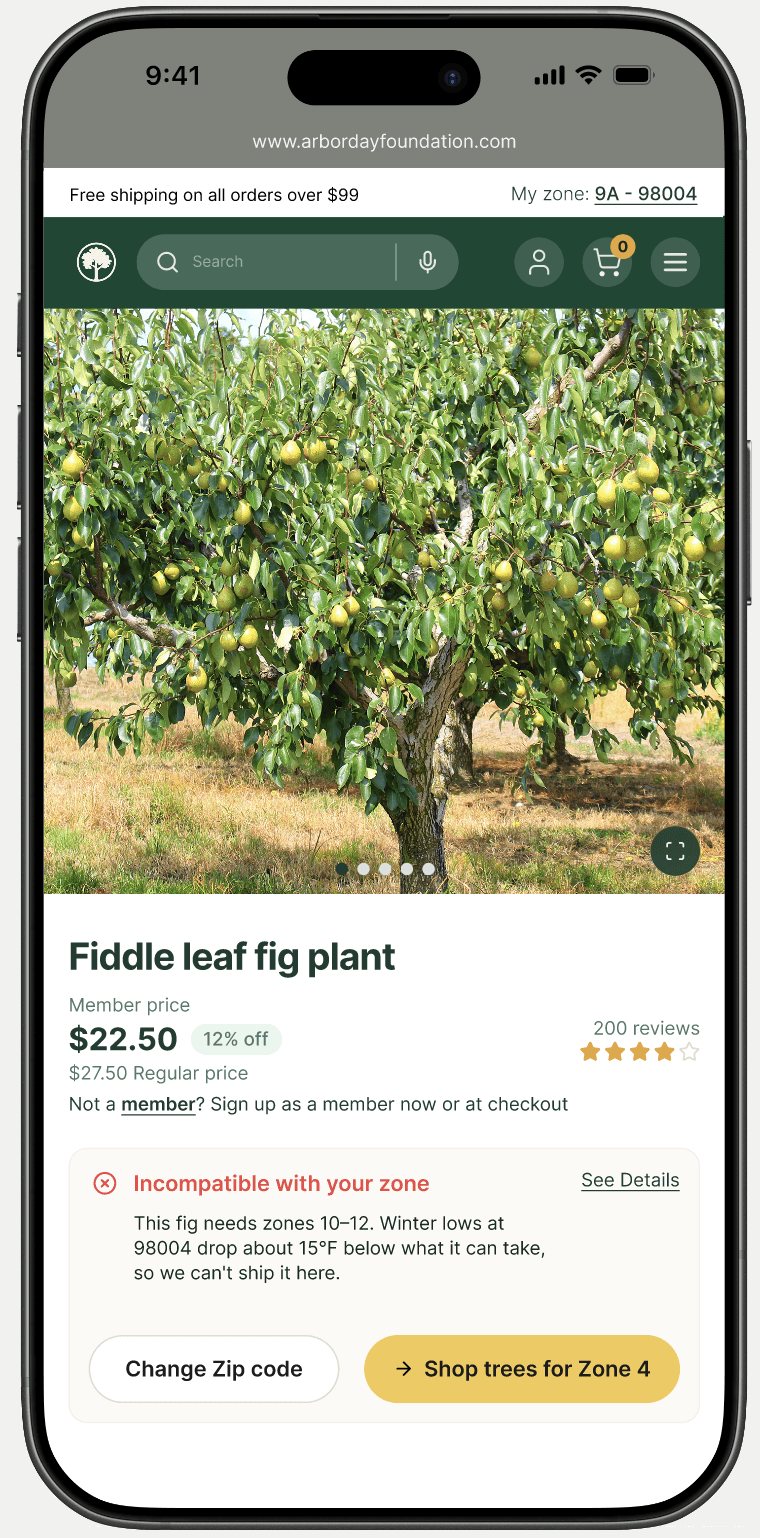
Location aware compatibility
Answer the customer's biggest question first: “Will this grow where I live?” Location-specific compatibility was surfaced directly within the PDP so customers could evaluate fit without leaving the purchase journey.
Compatible

Uncompatible
Iteration 1
Tried to show visual representation of product compatibility
Good Match for Zone 9A - 98004
Zip: 80303
Poor
Fair
Excellent
Safe to buy
92% compatibility confidence
Iteration 2
Removed the scale. Compatibility was mapped and verified, not predicted, so the UI states it as fact.
Available
Ships by Tue, July 12
Change
Compatible for your zone 9A-98004
Final Iteration
Moved the shipping details closer to the primary CTA on the page.
Compatible for your location
Zone 9A-98004
See Details
02/04
Proactive shipping clarity
Shipping timelines and expectations were surfaced earlier in the purchase journey, reducing uncertainty around when customers could expect their tree to arrive.

Iteration 1
The design didn't explained the why
Order now & we’ll ship on
Fri, Jul 24 (45 days)
1
Pre-order
Iteration 2
In testing, the timeline visual confused the users
Ships between 7/12/24 - 7/18/24
We ship when your climate is ready for planting
Today
Place order
Day 30
Nursery prep
Day 60
Ships to you
1
Pre-order
Final Iteration
kept the messaging straightforward and close to the CTA, along with explaining why the shipping would take time
1
Pre-order
Ships by the week of 07/12
We hold your tree until planting weather is right in your zone
Know more
Edge cases

Sold out for this season
The nursery is out for pear tree until next season, expected August 2025
See Details
Browse similar trees
Notify me
03/04
Scannable product & care information
Turn technical tree specifications into practical buying criteria. Added real delivery and UGC imagery, basic facts, and care guidance to help customers understand what they were buying and what ownership would require.


04/04
Product Fit
The PDP addressed immediate purchase uncertainty, but research also revealed opportunities elsewhere in the journey. I explored adjacent concepts to understand how Arbor Day could support customers earlier in tree selection.
Finding the right solution
Early explorations
Filters
🟢 Familiar + low effort
🔴 Assumes users know the criteria
Onboarding
🟢 Personalized upfront
🔴 Interrupts existing purchase journeys
Tree Wizard
🟢 Structured + predictable
🔴 Requires users to know how to answer
Conversational assistant
🟢 Works with unstructured intent
🔴 Higher technical complexity


Exploring beyond the PDP - Could conversational guidance help with questions the product page couldn't anticipate?
Research also surfaced highly contextual questions that static product information couldn't always answer. I explored a conversational assistant that could provide personalized guidance around compatibility, planting, and care.
Defining the AI assistant
Knowledge Base Inputs (Defined with Support team + Business team)
35+ SKUs tagged by zone, sun, soil, size, and ship window
Shipping rules by state and season
Plain-language glossary for bare-root, dormancy, and planting windows
Top 20 support intents converted into bot-ready answers
Conversation Guardrails
Answer only selection, shipping, care, and order-tracking questions
Say "I'm not certain" instead of guessing
No price promises or promotional commitments
Use an 8th grade reading level
Sound like a nursery expert, not a salesperson
Guided AI flow


The assistant confirms location before giving compatibility answers, since a wrong compatibility claim is high-stakes and hard to walk back

Recommends zone compatible
trees without losing context
🔴 Why it wasn't prioritized
The PDP was a more immediate opportunity to improve the core purchase journey, so we prioritized fixing information gaps there before introducing a new interaction model.
IMPACT
Bringing decision-critical information closer to purchase
improved both confidence and conversion.
"We're getting fewer 'when does it ship' calls and more questions about care instructions"
Support team sync, Week 8 post-launch
The results supported the core hypothesis: customers didn't necessarily need more information—they needed the right information at the moment they were deciding whether a tree was right for them.
REFLECTION
What I'd carry forward
01. Fix the core journey before adding a new interaction model
The conversational assistant could address highly specific questions, but improving the PDP solved a more immediate problem for more customers. I’d continue to test whether an existing experience can solve the problem before introducing a new surface.
02. More information doesn’t always create more confidence
Early explorations reinforced that adding content alone wasn't enough. What mattered was prioritizing compatibility, care, and shipping information around the decisions customers were already trying to make.
03. Measure individual interventions, not just the overall funnel
While the redesign improved add-to-cart and reduced support contacts, I’d instrument individual PDP changes more deliberately to understand which interventions contributed most to the outcome.
This summer I had the pleasure of working directly with Anjali through our Harris Entrepreneurship Program.
Anjali played a critical role in ideating and designing major deliverables for this program. Her ability to quickly analyze and problem-solve in an adaptable way was refreshing to observe. Anjali consistently sought and embraced feedback. This humble approach allowed her to conceptualize and produce user-centered design with tailored depth.
More importantly, Anjali was such a pleasure to be around as she consistently brought positive and enjoyable moments to our culture. Her high-quality work ethic and quick ability to create applicable solutions was impressive. There is no question in my mind that
Anjali will have a major hand in bringing forth new, user-centered designs for substantial impact.

AUSTIN MACKRILL,